Descobreix Pandipedia
Un directori creixent de respostes útils seleccionades per la comunitat de Pandi. Cerca a la col·lecció o explora els darrers descobriments.
2337 entrades disponibles
The Hero Who Carries the Unburied Names

Veiem alternatives:
- Modifica la consulta.
- Inicia un nou fil.
- Elimina les fonts (si s'han afegit manualment).

When Your Step Count Starts Counting You
Transcripció
Step counts can make movement visible and motivating. But when a number becomes a daily pass-or-fail test, exercise can stop feeling flexible. Compulsive exercise means an excessive, rigid, or difficult-to-control drive to exercise, even despite injury, illness, exhaustion, or disruption to daily life. Anxiety, guilt, or intense distress after missing a workout can be warning signs, especially when rest feels impossible. Other signals include exercising to compensate for eating, putting workouts ahead of relationships or responsibilities, or repeatedly trying and failing to cut back. The answer is not to avoid exercise. It is to put the numbers in perspective. U.S. guidelines focus on weekly activity minutes, not a required daily step count. Adults are advised to work toward 150 to 300 minutes of moderate activity each week, or 75 to 150 minutes of vigorous activity, plus muscle strengthening on at least two days. Increase gradually, vary your activities, and remember that cycling, swimming, and strength training may not produce many steps. Let a tracker provide feedback, not permission or punishment. Rest when your body needs it, and do not treat a missed number as failure. If exercise continues despite harm, or is affecting eating, sleep, work, relationships, or mood, speak with a doctor or qualified mental-health professional. The healthy goal is not the biggest number. It is movement that supports your life rather than controlling it.
Veiem alternatives:
- Modifica la consulta.
- Inicia un nou fil.
- Elimina les fonts (si s'han afegit manualment).
What new roles might emerge in hospitals as precision medicine becomes
As precision medicine becomes mainstream, hospitals and health systems are seeing shifts in roles and responsibilities across clinical, diagnostics, and pharmaceutical sectors. Anticipated roles and their required skills include:
- Genomic Pharmacist (or Pharmacogenomics Pharmacist): While traditional pharmacists primarily dispense medications and review drug orders, genomic pharmacists translate genetic and genomic data into defensible therapeutic recommendations [1]. They serve as practice-based leaders in pharmacogenomics [2], navigating logistical issues in genetic testing, pharmacy informatics, medication safety, drug information, and associated ethical considerations [3]. They also work in diagnostics and pharmaceutical sectors on companion diagnostics, labeling questions, and clinical content development at a system level rather than solely managing one patient at a time [4].
- Bioinformatics and Diagnostics Specialists: In support of precision medicine operations, health systems require specialized roles to handle data integration and software tools. For instance, staff use web-based bioinformatics platforms like Flype to securely accept multi-source data, handle secondary analysis and annotation of next-generation sequencing (NGS) data, maintain variant repositories, assist with clinical interpretation, and update variant annotations as literature evolves [5]. These roles differ from standard hospital IT positions by focusing specifically on managing, annotating, and interpreting complex genomic variants for electronic health record integration.
Would you also like to know how health systems handle the integration of genomic data into electronic health records?Resposta completada. Hi ha una opció de seguiment disponible.
Veiem alternatives:
- Modifica la consulta.
- Inicia un nou fil.
- Elimina les fonts (si s'han afegit manualment).
Digital transformation leadership: five source-reported voices, with original

In today’s era of volatility, there is no other way but to re-invent. The only sustainable advantage you can have over others is agility, that’s it. Because nothing else is sustainable, everything else you create, somebody else will replicate.Jeff Bezos, Amazon founder[3]




Veiem alternatives:
- Modifica la consulta.
- Inicia un nou fil.
- Elimina les fonts (si s'han afegit manualment).
The Harbor That Receives a Mountain

Veiem alternatives:
- Modifica la consulta.
- Inicia un nou fil.
- Elimina les fonts (si s'han afegit manualment).
Can Force Feedback Teach Surgical Skill?
Transcripció
Here is the case study. Force feedback simulators let trainees feel resistance while practicing surgical tasks, offering a way to build and assess technique before operating on a patient. In one simulator study, seven experienced surgeons were compared with nine novices. The experienced surgeons used greater force with nonlinear virtual materials and reproduced forces more accurately with softer nonlinear and linear materials. A separate haptic Fundamentals of Laparoscopic Surgery study found better trainee performance on tasks requiring controlled force. In validation testing with thirty-two participants, ratings for face validity, meaning the simulation felt realistic, averaged above four point six on a five-point scale. Content validity, meaning the tasks seemed relevant, averaged above four point zero. But this is not yet proof of real-world competency. The study said construct validity still needs to be established, meaning simulator scores must be shown to reflect actual surgical ability. Participants also wanted more realistic touch, and an earlier review of randomized trials found limited evidence for haptic feedback's effects. On cost, the searched economic sources did not provide a directly reported or validated cost reduction for force-feedback suturing training. So the defensible takeaway is potential cost avoidance by practicing in simulation rather than on patients, not a measured saving. Haptic simulation shows promising skill signals, but stronger validation and economic studies are still needed.
Veiem alternatives:
- Modifica la consulta.
- Inicia un nou fil.
- Elimina les fonts (si s'han afegit manualment).
What are the early warning signs of screen fatigue?
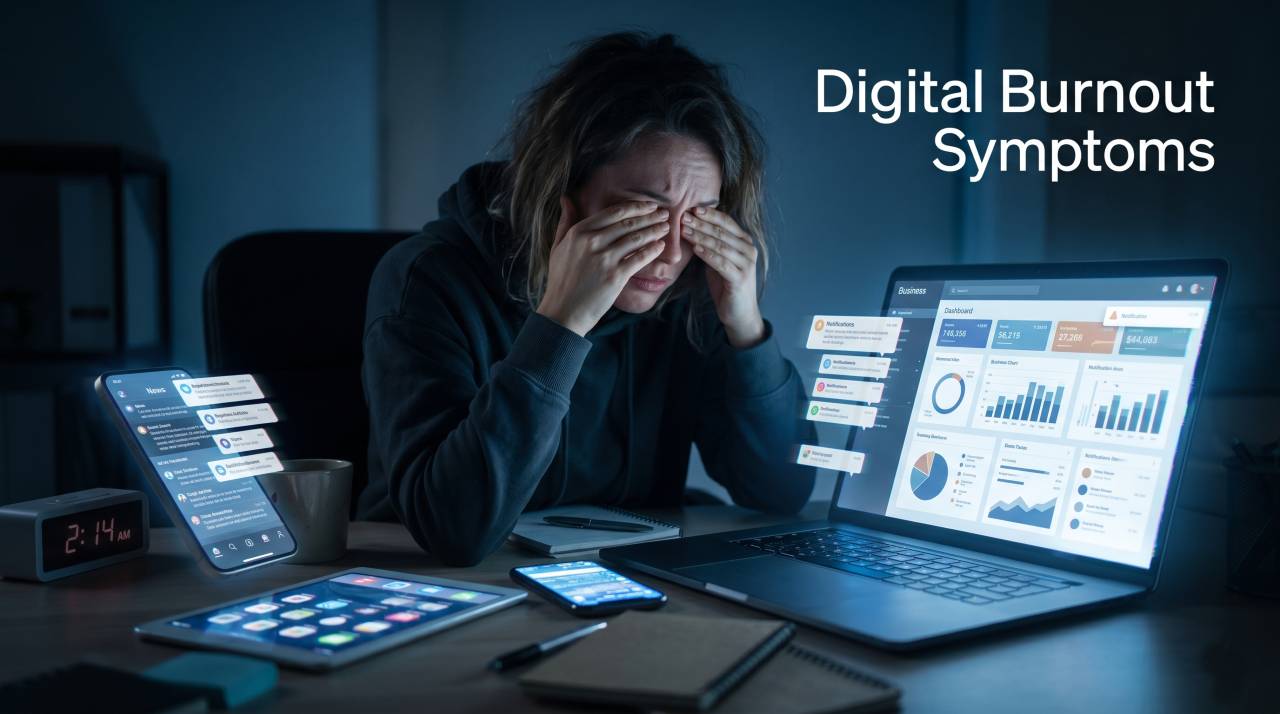
Screen fatigue and digital burnout present a mix of physical and mental cues that signal excessive screen exposure.
Physical Cues
- Eye Strain and Discomfort: Prolonged screen use frequently leads to ocular asthenopia, which involves eye discomfort, burning, dryness, itching, watering, and redness [1][2].
- Vision Changes: Straining to see digital text can cause blurred vision and aches behind the eyes [3].
- Musculoskeletal Pain: Poor posture and viewing angles can trigger tension headaches behind the forehead alongside stiffness and pain in the neck, shoulders, and lower back [4][5].
Mental Cues
- Cognitive Fatigue and Focus Issues: Excessive screen time impairs working memory and concentration, making it difficult to focus on deep work for more than a few minutes without getting distracted [6][7].
- Emotional Overload: Overstimulation can manifest as sudden irritability, low-level anxiety when opening work inboxes, or a general sense of dread and emotional flatness toward activities you once enjoyed [8].
- Sleep Disruption: Evening screen exposure suppresses melatonin production, creating a frustrating "tired but wired" state where you feel exhausted all day but remain restless or unable to switch off at night [9].
Quick Daily Actionable Checks
- The 20-20-20 Rule: Every 20 minutes of screen time, look at something at least 20 feet away for about 20 seconds to give your eyes a rest [10].
- Conscious Blinking: Make a conscious effort to blink more frequently to moisten the surface of your eyes and combat dryness [11].
- Scheduled Screen-Free Breaks: Take a true 10 to 15-minute break away from all digital devices every couple of hours to stand up, go outside, or make tea without your phone [12].
- Workspace Ergonomics: Adjust your display so the center of the screen sits about 4 to 5 inches below eye level (roughly 15 to 20 degrees down) to reduce neck and shoulder strain [13][14].
Would you also like to know how to adjust screen contrast and text size to reduce digital eye strain?Resposta completada. Hi ha una opció de seguiment disponible.
Veiem alternatives:
- Modifica la consulta.
- Inicia un nou fil.
- Elimina les fonts (si s'han afegit manualment).
Gemini 4: The Spacewalk Beyond the Hatch
Transcripció
In 1965, during Gemini 4, Edward White made America’s first spacewalk. It lasted 36 minutes, and its purpose was practical: to show that a person could work outside a spacecraft, while testing the Hand-Held Maneuvering Unit. White’s exit began with the hatch. Its latch jammed, and the stiff hatch had to be pushed open. Standing in his seat, he installed a sixteen-millimetre camera outside the capsule. He then used the Hand-Held Maneuvering Unit for a brief departure. Its compressed-oxygen supply lasted only about twenty seconds, but the test was successful. The umbilical was not a precision steering system. It supplied oxygen, carried communications and instrumentation lines, and acted as a tether to limit how far White could move from Gemini 4. Returning was less graceful. The hatch would not close, and White struggled with it for five minutes. During that effort, he exceeded the cooling margin of his chest-mounted ventilation unit. His visor fogged slightly, and sweat reached his eyes before repressurisation allowed him to remove his helmet. The lesson was clear: an EVA depended not only on movement outside, but on reliable spacecraft interfaces and disciplined procedures after the work was done.
Veiem alternatives:
- Modifica la consulta.
- Inicia un nou fil.
- Elimina les fonts (si s'han afegit manualment).
Who Gets to Name a Genre?

Cyberpunk did not burst into existence through a single author's decree; rather, it became a recognizable subgenre through a gradual chain of terminology, editorial infrastructure, and cultural legitimization [1]. The term itself was consciously coined by Bruce Bethke as the title for his 1983 short story published in Amazing Stories [2]. Bethke’s original premise followed a group of teenage hackers and computer virtuosos in a near-future setting who combined the ethical vacuity and rebellious spirit of youth with high-level technical fluency to outsmart authority figures and parental control [3][4]. While Bethke named the beast [5], he did not invent the entire movement alone [6].
The transformation from an isolated title into a stabilized movement label relied heavily on editorial promotion and broader cultural recognition. In 1984, influential editor and author Gardner Dozois adopted the term in a Washington Post article and subsequent editorials, using "cyberpunk" to categorize a new school of hard-edged, high-tech science fiction writers such as William Gibson, Bruce Sterling, and Pat Cadigan [7]. Bolstered by the massive success of Gibson's 1984 novel Neuromancer, this editorial framing cemented cyberpunk as a recognized genre movement defined by its lowlife-and-hightech ethos [8].
For newcomers navigating this history, a clear distinction helps: a coined term is simply a manufactured word created to capture a specific cultural friction, whereas a stabilized genre category represents a broader literary and aesthetic movement recognized across publishing, media, and critical infrastructure [9].
Would you also like to know how William Gibson's Neuromancer helped shape the cyberpunk movement?Resposta completada. Hi ha una opció de seguiment disponible.
Veiem alternatives:
- Modifica la consulta.
- Inicia un nou fil.
- Elimina les fonts (si s'han afegit manualment).
Glass civic architecture where clean technology meets living water

Veiem alternatives:
- Modifica la consulta.
- Inicia un nou fil.
- Elimina les fonts (si s'han afegit manualment).